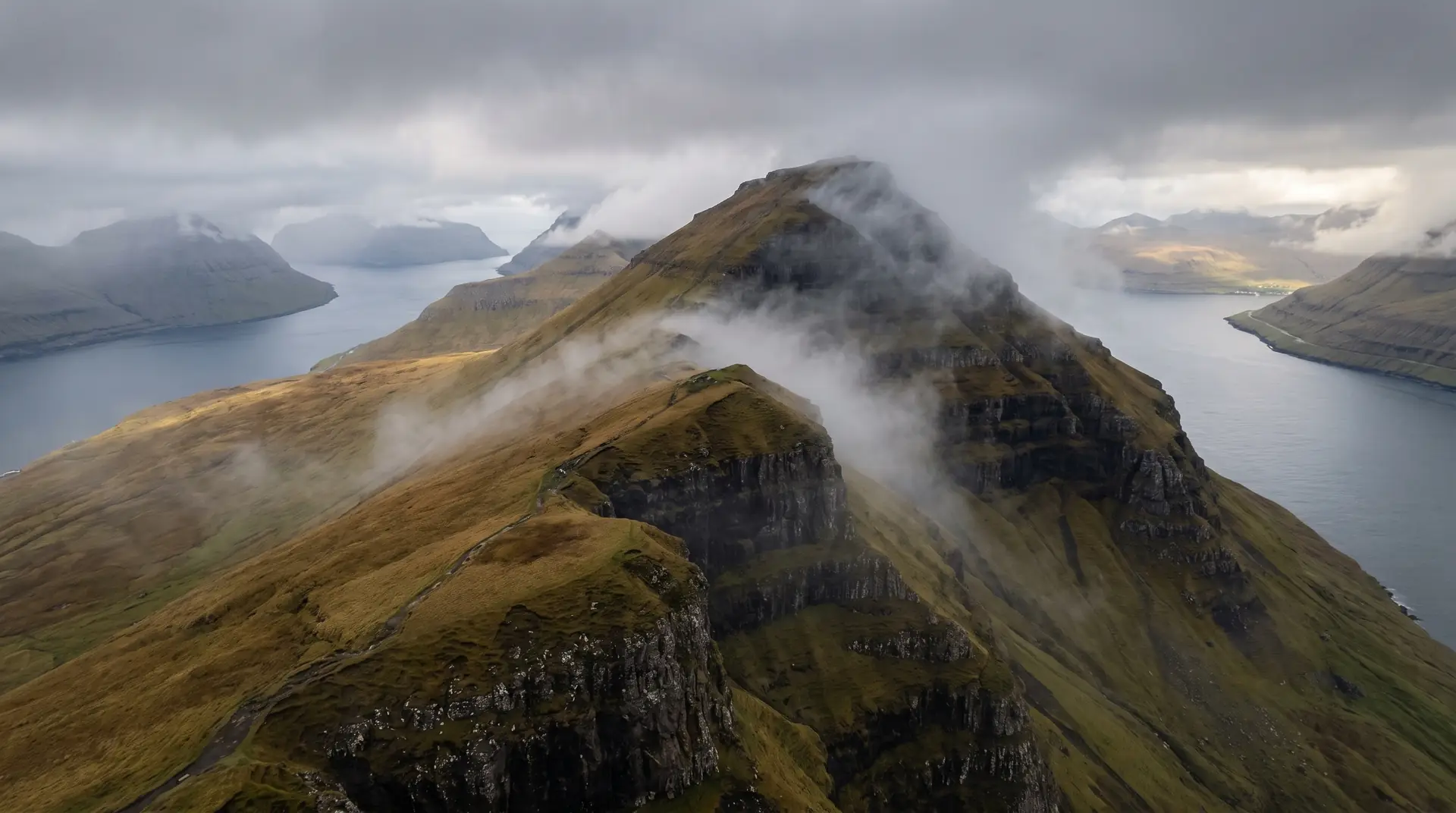
The year is a light budget, not a temperature range
Tórshavn's coldest month averages 6.0°C by day and 1.6°C at night. Its warmest averages 13.3°C and 9.3°C. That is a seven-degree swing across an entire year, which tells you the Faroese calendar is not organised around warmth. It is organised around light.
The two numbers worth planning against are daylight hours and days with measurable rain. December gives you somewhere around five and a half hours of sun above the horizon and rain on roughly twenty days of the month. June gives you close to twenty hours of light and rain on nine. Same archipelago, entirely different trip.
Wind belongs in the same list, though it resists averaging. A still July evening and a February gale are the same islands behaving differently, and the gale arrives more often than most visitors plan for in any month of the year.
January to March — the dark end
January is the hardest month and the most atmospheric: 6.2°C and 2.1°C on average, rain on about 21 days, and roughly six hours of daylight at midmonth. Nothing about it is comfortable and everything about it photographs. Storm-watchers come now on purpose.
February is the coldest month on paper — 6.0°C and 1.6°C — yet it treats you better: rain on about 17 days, daylight stretching toward eight hours. It is the best-value month in the year for anyone who actually wants to be outdoors: cheaper than summer, brighter than December, and still unmistakably winter.
March keeps the unsettled weather (rain on about 19 days) but hands back real daylight, around eleven hours. That makes it the first month where a road-trip day works properly. Higher trails stay marginal; wind and showers still decide the afternoon.
April and May — the opening
April averages 7.6°C and 3.2°C with rain on about 15 days, one of the driest stretches in the Tórshavn normals, and daylight is up to roughly fourteen hours. Spring reads as real rather than theoretical, though the weather can still flip inside an hour.
May is the best-balanced month of the year. Averages of 9.3°C and 5.0°C, rain on about 12 days, and something like eighteen hours of light. The hills green up, the ridges keep their snow, and the visitor numbers have not arrived yet. The first puffins come ashore in early May and the season's first ferries follow them.
June to August — the open months
June is the clearest winner for anyone whose trip depends on being outside all day: 11.3°C and 7.3°C, the lowest rain-day count of the year at about nine, and roughly twenty hours of usable light. Hikers and photographers should start here and only move for a reason.
July is the cultural peak rather than the meteorological one — 12.9°C and 9.1°C, rain on about eleven days. Ólavsøka lands at the end of the month and pulls a large share of the country into Tórshavn. Accommodation and hire cars price and sell accordingly.
August holds the warmest averages of the year at 13.3°C and 9.3°C but rain climbs back to about 13 days and daylight has already fallen to around sixteen hours. After midmonth the sense of peak summer starts to taper, which is exactly when the light gets interesting again.
The summer calendar
Ólavsøka, the national holiday, is held on 28 and 29 July with the main celebrations in Tórshavn: parliamentary ceremony, rowing races, live music, art exhibitions and sport, closing with a mass sing-along at midnight on the 29th. It is the single biggest concentration point in the Faroese year. If you want to be in the capital for it, book central accommodation months out rather than weeks.
The G! Festival takes place in Gøta and Summartónar runs as a summer music series around Tórshavn. Both are fixtures of the summer calendar rather than fixed calendar dates — the exact days move year to year, so confirm them on visitfaroeislands.com before you commit to flights.
Traditional rowing is most visible around Ólavsøka, when the races are part of the national programme. For seabirds, summer is the dependable window: the colonies are at full strength and puffins are at their most reliable from late spring through the summer. The Mykines boat sails daily from May to August, less often in spring and autumn, and is weather-dependent; check the current sailing dates with SSL rather than assuming a fixed start and end.
September to December — the long close
September is the classic shoulder: 11.9°C and 8.1°C, rain on about 16 days, thirteen hours of light, and far fewer people. The weather turns more dramatic, which is a cost for hikers and a gift for photographers.
October is the most cinematic month on the calendar and the riskiest. Averages drop to 9.6°C and 5.7°C, rain arrives on about 19 days, daylight falls to around ten hours, and the first real storm systems come through. Hiking windows get short and need watching.
November and December are where the trade stops being worth it for most trips. November averages 7.6°C and 3.6°C with rain on about 20 days and roughly seven hours of light. December is the worst-value month of the year: the shortest daylight of all, around five and a half hours, paired with rain on about 20 days. You pay full logistical cost for the least usable time outdoors. Come in December only if winter mood is the point of the trip.
Picking a month for what you came for
Hikers: June, with May close behind if you would rather trade a little reliability for emptier trails. Photographers: May or June for dependable working conditions, October if you want weather as the subject and can absorb losing days to it.
Storm-watchers: December, with January a close second — the darkest days and the highest rain-day counts of the year. Budget travellers: February, which is brighter and less saturated than November and sits well outside the summer premium. First-time visitors who want everything open, including ferries and puffin colonies: June through August.